Clamp Meter vs Multimeter: Key Differences, Pros, and Which One You Should Buy (2026 Guide)
Table of ContentsClamp Meter vs Multimeter: The Ultimate 2026 Buying Guide & Comparison
Whether you are a seasoned electrical engineer diagnosing a three-phase motor or a DIY enthusiast fixing a broken toaster, your safety and efficiency depend on using the right tool. The debate between the clamp meter and the multimeter is as old as modern electrical testing itself.
While both devices measure electrical properties, they are fundamentally engineered for completely different environments. A clamp meter acts as a high-current safety shield, allowing you to measure current without cutting wires. A multimeter, on the other hand, is the ultimate Swiss Army knife for precision diagnostics. Choosing the wrong tool can lead to blown fuses, destroyed motherboards, or severe electrical hazards.
⚡ Quick Answer: Which Tool Do You Need?
If you need a fast recommendation based on your profession or task:
- Best for high AC/DC current: Clamp Meter
- Best for circuit board repair: Multimeter
- Best for HVAC technicians: Clamp Meter
- Best for automotive testing: Multimeter
- Best for residential wiring: Clamp Meter
- Best for absolute beginners: Multimeter
1. The Digital Multimeter (DMM): Precision & Versatility
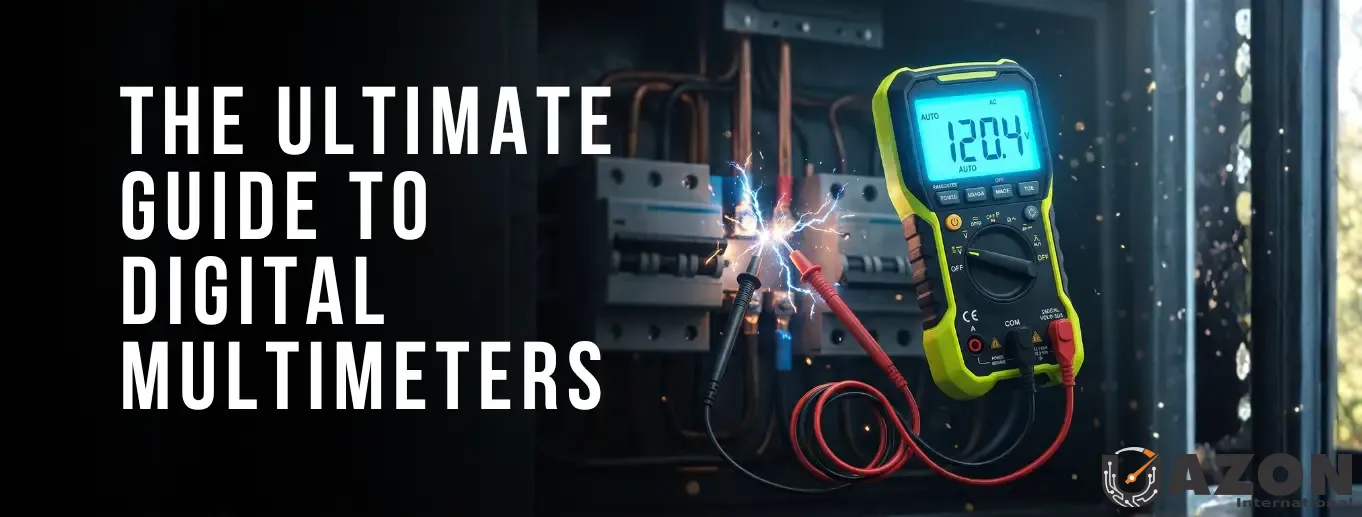
A Digital Multimeter is the foundational tool of electronics. It measures voltage, resistance, and current by becoming a physical part of the electrical circuit. Because multimeters physically interface with the copper wire via probes, they offer unparalleled accuracy for microscopic electrical variations.
How It Uses Ohm's Law
Multimeters are essentially calculators for Ohm's Law. When you test a resistor, the multimeter outputs a known tiny voltage, measures the resulting current, and calculates resistance using $R = \frac{V}{I}$. For power diagnostics, it relies on the principle of $$P = V \times I$$. This precision makes it irreplaceable for low-voltage IT and PCB diagnostics.
Key Strengths of a Multimeter:
- Millivolt Precision: Can detect drops as small as 0.1mV.
- Component Testing: Includes modes for testing diodes, capacitors, and transistors.
- Ghost Voltage Detection: High-end models have LoZ (Low Impedance) modes to eliminate false readings.
2. The Clamp Meter: Safety & Speed
Originally designed as a single-purpose tool for electricians to measure AC current, the modern Clamp Meter has evolved. By opening the jaws and clamping around a single live wire, the meter measures the magnetic field generated by the current flow. It does not require you to cut the wire, shut off the power, or expose yourself to live copper.
The Science: Current Transformers vs. Hall Effect
Basic clamp meters use a Current Transformer to measure AC current. However, if you are buying a clamp meter in 2026 for solar or automotive (DC power), you must ensure it has a Hall Effect sensor. Without a Hall Effect sensor, a clamp meter cannot measure DC current.
Key Strengths of a Clamp Meter:
- Zero Interruption: Machines stay running while you measure their power draw.
- Massive Current Handling: Easily measures 400A to 1000A+ (Multimeters max out at 10A and blow a fuse).
- Inrush Current Measurement: Can capture the massive surge of electricity a motor uses in the first 100 milliseconds of starting up.
Head-to-Head: Which Tool Wins?
1. Measuring Current (Amps)
Winner: Clamp Meter
To measure current with a multimeter, you must break the circuit and run the power through the meter. If you exceed 10 Amps, you will blow the internal fuse. A clamp meter measures hundreds of amps instantly and safely from the outside of the wire.
2. Measuring Voltage & Resistance
Winner: Multimeter
While clamp meters have test leads for voltage, their internal resolution is much lower. A multimeter provides razor-sharp accuracy for voltage drops, testing resistors, and checking continuity on motherboards.
3. Safety & Arc Flash Risk
Winner: Clamp Meter
Working in a 480V industrial panel? A clamp meter keeps your hands away from live copper. Multimeter probes require steady hands; one slip can cause a deadly arc flash.
| Feature / Specification | 🗜️ Clamp Meter | 🎛️ Multimeter |
|---|---|---|
| Max Current Limit | Up to 1000A+ (Excellent) | Usually max 10A (Poor) |
| Resolution / Precision | Moderate (1-10mA) | Extremely High (0.1µA) |
| Component Diagnostics | Basic | Advanced (Diodes, Caps) |
| Space Requirements | Requires room for the jaw | Probes fit into tight spaces |
Which Tool is Best for Your Industry?
❄️ HVAC & Refrigeration
HVAC relies heavily on motors, compressors, and capacitors. A Clamp Meter is essential for checking compressor amp draw without pulling wires. However, technicians still need to test microfarads on start capacitors, meaning a combo clamp meter with capacitance functions is the holy grail for HVAC.
🚗 Automotive Repair
Modern EVs and gas cars use 12V/48V DC systems and complex CAN bus networks. A Multimeter is strictly better for checking sensor voltages, alternator diodes, and parasitic battery drains. The only time mechanics need a clamp meter is a specialized DC clamp for testing starter motor amperage.
🏭 Industrial Maintenance
In factories dealing with 3-phase power and heavy machinery, safety is paramount. The Clamp Meter is the undisputed king. Industrial electricians use them to balance phase loads and check for motor stalls safely from outside the cabinet.
🏠 Residential DIY & Hobbyists
If you are fixing a lamp, checking AA batteries, or installing a smart switch, a Digital Multimeter gives you 99% of what you need for under $50. Clamp meters are overkill for basic home tasks unless you are upgrading your main breaker panel.
🛒 Must-Have Specs for 2026 Models
Before buying either tool from top brands like Fluke, Klein, or Fieldpiece, ensure they meet these modern standards:
- True RMS (Root Mean Square): Essential for accurate readings on LED drivers, variable speed motors, and computer power supplies. Non-True RMS meters will give fake readings on modern electronics.
- CAT III 600V / CAT IV 300V Minimum: Never buy an unrated meter. CAT III protects you from blasts in the breaker panel. CAT IV protects you at the utility meter level.
- High Display Counts: Look for "6000 Count" or "10000 Count" displays. It dictates the resolution of your screen before the decimal point moves.
The Final Verdict
There is no single "best" tool, only the right tool for the job. In fact, 90% of professional electricians carry both in their toolbag.
🗜️ Buy a Clamp Meter if...
- You work on live breaker panels.
- You diagnose motors & HVAC units.
- You deal with currents over 10 Amps.
🎛️ Buy a Multimeter if...
- You repair circuit boards/PCs.
- You do automotive diagnostics.
- You need extreme precision for small voltages.